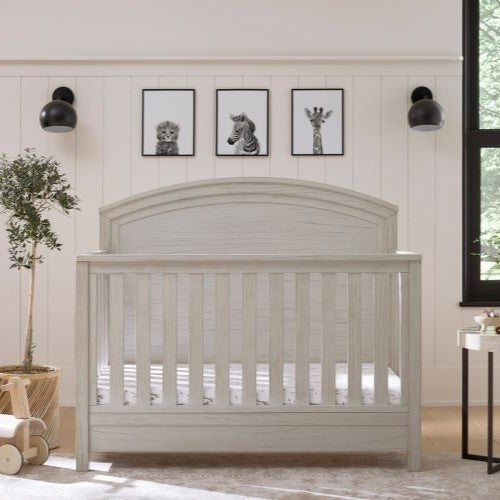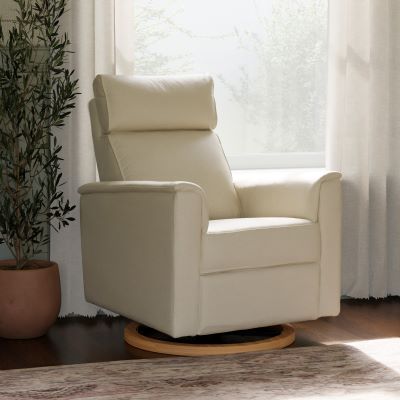
Nursery & Design There's a difference between a room that looks old and a room that looks like it's always been there. Most vintage nursery ideas circulating online land in the first category: a room assembled from a mood board, sealed off from the rest of the home, lovely in a photograph. The second is harder to describe and much easier to live in. It comes down to a small number of decisions about silhouette, material, and how each piece relates to the next, letting the room feel collected rather than overly styled. Vintage-inspired nursery featuring the Liberty 4-in-1 Convertible Crib, Liberty Assembled Nightstand, and the Willa Plus with Power Headrest. What makes a nursery look vintage? The short answer A nursery reads as vintage through silhouette and material rather than decoration: turned spindles and spool detailing, scalloped or curved millwork, solid wood in warm tones, aged brass or iron hardware, and heritage textiles like gingham, ticking stripe, and small-scale florals. The result feels rooted in the past while remaining timeless enough to sit naturally within the home today. Turned Spindles The spindle is the shape most people are picturing when they say vintage, even when they can't name it. It's often called Jenny Lind, after the Swedish opera singer who toured America beginning in 1850. The craze around her tour attached her name to nearly everything sold at the time, including the spool-turned beds she was said to have slept in. What keeps it from feeling overly themed is that the detail is entirely structural. A turned spindle isn't applied ornament stuck to a flat panel. It's the support itself, shaped. That's why the silhouette has survived nearly two centuries of taste cycling past it. A turned spindle isn't ornament stuck to a panel.It's the support itself, shaped. Scalloped and Curved Millwork A scalloped apron along the base of a crib, a bed, or a shelf does something a straight rail can't. It breaks the horizontal line and softens the whole piece without adding a single decorative object to the room. The same is true of an arched back on a hutch or a gently bowed chair rail. These are the details that give a room its character before anything is hung on the walls. Rounded Posts and Honest Joinery Sharp corners and visible fasteners tend to feel more contemporary. Rounded posts, concealed hardware, and dovetailed drawers are rooted in traditional furniture making, details that have been valued for their craftsmanship and durability across generations. This is also where the vintage instinct and the safety requirement happen to agree. Rounded posts and concealed hardware bring a classic feel to the nursery while meeting the practical needs of modern family life. Hardware That Adds Character The single fastest way to date a piece of furniture to the present decade is a bright chrome pull. Vintage iron, aged brass, unlacquered gold, and simple wooden peg hooks all move a room backward in time immediately, and they cost almost nothing to change. If you inherit or buy a piece that's right in every way except the hardware, the hardware is the easiest thing to fix. Heritage Textiles Gingham. Ticking stripe. Small-scale florals. Toile. Patterns with a sense of history, especially those that feel familiar, understated, and timeless. Scale matters more than pattern here. A large, bold repeat reads modern almost regardless of the motif, while a small, dense pattern reads inherited. This is where a heritage floral wallpaper can carry an entire room, and why a single well-chosen print often does more than four coordinating ones. Morris & Co. x Namesake Crewe Recliner and Swivel Glider in Strawberry Thief in Fig & Thyme. Willa Plus Power Glider Recliner w/ Power Headrest in Tan Gingham. Devon Recliner and Swivel Glider in Performance Dusty Rose Eco-Basketweave. Start With the Furniture Color trends come and go, but the furniture is often the starting point for the room you'll live with for years. Warm woods, painted finishes, and classic silhouettes can work with a wide range of palettes, from soft neutrals to richer, more expressive colors. Rather than choosing a wall color first and trying to make the furniture work around it, start with the pieces you love. Look at how the finish changes in natural and evening light, then build the rest of the room around it. The right palette should complement the furniture without competing with it. And when you're deciding between finishes, seeing the color in person makes all the difference. Our free wood and finish swatches make it easy to compare options at home, in your own light, alongside the paint, textiles, and other pieces you're considering. Mixing Genuinely Old Pieces with New Ones The charm comes from the mix. Vintage-inspired silhouettes can be paired with modern furniture, personal pieces, and a few details that feel collected over time, creating a nursery that feels layered. The proportion that tends to work is roughly seventy-thirty, split along a functional line rather than an aesthetic one: New, because they hold weight and must meet current standards: the crib, the dresser, the chair, the mattress, the shelving that gets anchored to a wall. Found, because they carry the character: a lamp, a small chair, a mirror, a quilt, a stack of books with cloth spines, a framed print, a basket, a rug with some wear in it. The found objects do the emotional work. The new pieces do the structural work. When people say a room "feels collected," this split is usually what they're responding to and it's also why a room like this can't be finished in a weekend, which is fine. It isn't supposed to be. Abigail 3-in-1 Convertible Crib in Vintage Gold. Liberty Assembled Bookcase in Juniper. What to Buy New, and What Can Be Found Safe to find secondhand, with a little care: textiles that can be washed, art and frames, lamps that can be rewired, baskets, books, small side tables, and mirrors β anchored and hung well away from the crib. The one exception The crib is the exception, and it isn't a close call. The CPSC advises against using any crib more than ten years old or one that's been altered, and both the CPSC and the American Academy of Pediatrics advise against using a crib that predates the current federal standard. Traditional drop-side cribs were banned from manufacture, sale, and resale in the U.S. under the CPSC's 2011 crib safety rule. Mandatory slat-spacing limits and updated mattress-support requirements also came well after most vintage cribs were made. Antique finishes are also more likely to contain lead, and a crib that has been assembled and disassembled through several households has usually lost some structural integrity along the way. This is the one place where the heritage instinct must give way, and the good news is that it doesn't cost you the look. A Liberty 3-in-1 Convertible Spindle Crib built to the current standard gives you the same silhouette, in solid wood, with the certifications underneath it β GREENGUARD Gold for emissions, and compliance with the federal crib standard for structure. Liberty 3-in-1 Convertible Spindle Crib in Natural Walnut GREENGUARD Gold Certified | FSC Certified The same caution applies more gently to a painted vintage dresser. Anything finished before 1978 may carry lead paint, and a changing surface is the last place you want it. Making It Continue Past the Nursery The real test of a room built this way isn't how it photographs at three months. It's what happens at four years. A spindle crib that converts to a toddler bed and then to a daybed keeps the same silhouette in the room while the child outgrows three separate stages of it. The dresser loses its changing tray and becomes a dresser. A tiered wall shelf that held a sound machine and a folded muslin holds books and small collected objects instead. Nothing gets replaced. The room just gets edited. That's the quiet argument for heritage design in a nursery, and it has very little to do with nostalgia. A room built around a small number of well-made pieces and a warm, unsaturated palette doesn't need to be redone when the crib goes because the crib was never the thing holding it together. Liberty 3-in-1 Convertible Crib in Natural Walnut at the Toddler Bed stage. A nursery should feel like a natural extension of the home, not a room designed around a single aesthetic. Vintage-inspired details bring warmth and character, while thoughtful modern pieces make the space practical for everyday life. The goal isn't to recreate another era, but to borrow the details that have endured and make room for the life happening around them. The result is a nursery that feels warm, considered, and timeless enough to belong in your home long after the crib is gone. Common Questions What makes a nursery look vintage? A nursery reads as vintage through silhouette and material rather than decoration: turned spindles and spool detailing, scalloped or curved millwork, solid wood in warm tones, aged brass or iron hardware, and heritage textiles like gingham, ticking stripe, and small-scale florals. Are vintage or antique cribs safe to use? No. The CPSC advises against using any crib more than ten years old or one that has been altered, and traditional drop-side cribs were banned from manufacture, sale, and resale under the CPSC's 2011 crib safety rule. Antique finishes are also more likely to contain lead. Choose a new crib built to the current standard in a heritage silhouette instead. How do you mix antique and new furniture in a nursery? Split the room by function rather than style. Buy new for anything structural or weight-bearing such as a crib, dresser, chair, mattress, anchored shelving. Search secondhand for the pieces that carry character, like lamps, mirrors, quilts, framed art, and rugs. Roughly seventy percent new to thirty percent found tends to read as collected rather than staged. A room built slowly, piece by piece, ends up feelingmore like yours than one finished all at once. Browse the Liberty collection Order free swatches Sources: U.S. Consumer Product Safety Commission, federal crib standard 16 CFR 1219 and the 2011 crib safety rule Β· American Academy of Pediatrics, guidance on secondhand cribs.