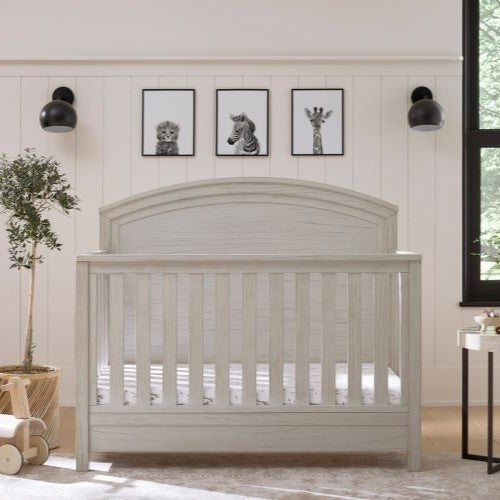
Beautiful design is only one part of what makes a crib right for your nursery. Behind every silhouette, finish, and carefully considered detail are safety requirements designed to support a secure sleep environment. From slat spacing to mattress support and durable hardware, these features are built into the crib, even when they aren’t immediately visible. With crib safety standards continuing to evolve, 2026 is a good opportunity to revisit what these guidelines mean for families. Here’s what’s new, what hasn’t changed, and what to look for as you choose a crib. 2⅜″Maximum space between crib slats 1/16″Maximum corner post height 35″Child's height to move on from the crib 10 yrsOldest crib the CPSC advises using What changed in 2026 Two federal standards were updated this year, both by the U.S. Consumer Product Safety Commission (CPSC). Effective May 3, 2026 Crib mattresses The standard now incorporates ASTM F2933-25. It widens the fit and dimension requirements for aftermarket mattresses made for mini cribs and play yards, and ties them more closely to the products they go into. Effective August 1, 2026 Full-size cribs The standard now incorporates ASTM F1169-25. Cribs with mesh or fabric sides must meet new barrier requirements, and cribs with sides that lower carry a new warning: never leave an infant inside with the sides down. What hasn't changed The foundation of every crib sold today was laid over the last fifteen years. 2011 The federal crib rule ends the manufacture, sale, and resale of traditional drop-side cribs, and requires stronger slats, sturdier mattress supports, hardware that resists loosening, and durability testing that simulates years of use. 2022 The Safe Sleep for Babies Act makes padded crib bumpers and inclined infant sleepers illegal to sell in the U.S. 2023 The STURDY Act sets a mandatory tip-over standard for dressers and other clothing storage. 2026 Updated standards for crib mattresses and full-size cribs take effect. Slat spacing still can't exceed 2⅜ inches, about the width of a soda can. Corner posts still can't rise more than 1/16 of an inch above the end panels, so nothing can catch on clothing. What makes a crib safe in 2026? A crib is safe when it meets the current federal standard (16 CFR 1219, now incorporating ASTM F1169-25), has fixed sides, slats no more than 2⅜ inches apart, and a firm mattress that fits snugly. It should be less than ten years old, unaltered, and kept bare: no bumpers, pillows, blankets, or soft toys. The sleep space itself A safe sleep space is about more than the crib itself. What goes inside matters, too. The American Academy of Pediatrics (AAP) recommends keeping your baby’s sleep space simple, with a firm, flat mattress and a fitted sheet, and no loose bedding or soft objects. It may feel minimal compared to the rest of a thoughtfully designed nursery, filled with soft textures and cozy details. But there’s room for both. Keep the softness in the spaces around the crib, from the nursery chair and rug to the quilt draped over the dresser, and let your baby’s sleep space remain clear. On the back Lay your baby on their back for every sleep, naps included, until the first birthday. Firm and flat A fitted sheet made for that mattress, and nothing else. Bare No bumpers, pillows, positioners, quilts, or stuffed animals. A wearable blanket keeps a baby warm without anything loose in the crib. Close by Share a room, but not a bed, for at least the first six months. What to look for in the crib you choose Whether it's new, handed down, or still in its box, the questions are the same. A label and a date. Every crib sold in the U.S. carries a manufacture date and a statement of compliance. If you can't find one, don't use it. Age and history. The CPSC advises against any crib more than ten years old, or one that has been repaired, altered, or is missing original parts. The soda-can test. If a can slides between the slats, the spacing is too wide. Mattress fit. Press the mattress into one corner. If more than two fingers fit between its edge and the crib, the mattress is too small. Hardware. Every bolt tight, nothing cracked, nothing missing, no splinters along the rails. The finish. Any crib finished before 1978 may carry lead paint. Current cribs must meet federal limits on lead in surface coatings. A crib with honest construction makes most of this list easy. As the crib converts A convertible crib is one piece that has to be safe at every stage, which means the safety work isn't finished on the day it's assembled. Lower the mattress early Move it down before a baby can sit up unassisted, and to its lowest position before they can pull to standing. Know when it's time to move on The CPSC suggests transitioning out of the crib once a child reaches 35 inches tall, or when the top rail sits below chest height while they stand. Use only the kit made for your crib A conversion kit from the same maker, built for that model, is the only one tested with it. Anchor everything else Dressers sold in the U.S. must meet the STURDY Act's tip-over standard, and they still come with anti-tip hardware for a reason. A dresser beside a crib is the first thing a climbing child reaches for. How we think about it At Namesake, safety is the part of the work we hope you never have to think about. The detail and the requirement The turned spindles that give the Liberty 3-in-1 Convertible Spindle Crib its heritage silhouette are the same spindles that are spaced, tested, and certified to the current standard. Shop the Liberty collection cribs The pieces that do the quiet work Made for the crib it converts, and tested with it. Conversion Kits Built to the tip-over standard, with anti-tip hardware included. Dressers Firm, flat, and sized to fit a full-size crib snugly. Crib Mattresses Questions we hear often Is a crib made before August 2026 still safe to use? Yes, if it met the federal standard in place when it was made, is less than ten years old, has never been altered, and has all its original parts. The 2026 update mainly adds requirements for full-size cribs with mesh or fabric sides. How far apart should crib slats be? No more than 2⅜ inches, about the width of a soda can. If a can slides between the slats, the spacing is too wide. When should I lower the crib mattress? Lower it before your baby can sit up unassisted, and move it to the lowest position before they can pull to standing. Are crib bumpers allowed? No. Since 2022, the Safe Sleep for Babies Act has made padded crib bumpers illegal to sell in the U.S., and the AAP recommends keeping the crib completely bare.